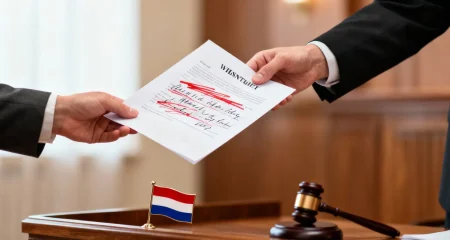
Under Dutch law, simple assault (mishandeling) is punishable by up to three years in prison under Article 300 of the Dutch Criminal Code (Wetboek van Strafrecht, Sr), and intentionally causing grievous bodily harm by up to eight years under Article 302 Sr. Force is not punishable if it was necessary self-defence (noodweer) against an immediate, unlawful attack (Article 41 Sr).
Threats, public violence in a group and assault on specific victims are separate offences or aggravated forms. Which category the public prosecutor (officier van justitie) charges largely determines the possible sentence.

Which assault offences does Dutch law distinguish?
The Criminal Code grades assault by the injury caused and by intent. The more serious the injury and the more planned the act, the higher the maximum sentence.
- Simple assault (Article 300(1) Sr): causing pain or injury on purpose, such as a punch or a kick; maximum three years or a fourth-category fine.
- Assault resulting in grievous bodily harm (Article 300(2) Sr): the serious injury was not intended; maximum four years.
- Assault resulting in death (Article 300(3) Sr): maximum six years.
- Premeditated assault (Article 301 Sr): the act was planned in advance; higher maximums apply.
- Grievous bodily harm (zware mishandeling, Article 302 Sr): intentionally causing serious injury, such as broken bones or permanent damage; maximum eight years, or ten years if the victim dies.
Under Article 304 Sr, the maximum sentence is increased when the assault is committed against, for example, a family member or a public official carrying out his duties. Under its own guidelines, the public prosecutor also demands higher sentences for violence against emergency workers and others with a public task.
How are threats and public violence treated?
A threat (bedreiging) is a separate offence under Article 285 Sr, even if no one is touched. Public violence in a group (openlijke geweldpleging) falls under Article 141 Sr, with a maximum of four years and six months.
A threat is punishable if it concerns a serious crime, such as an attack on someone’s life or grievous bodily harm, and could reasonably make the victim fear it would be carried out. Under Article 141 Sr, everyone who openly and jointly uses violence against persons or property can be prosecuted. If the violence causes bodily injury, the maximum rises to six years.

When is the use of force lawful self-defence?
Force is lawful if it was necessary to defend yourself, someone else or property against an immediate and unlawful attack (41. cikk). The court checks whether your response was proportionate and whether you could reasonably have avoided the attack.
If you went too far because the attack caused a strong emotional reaction, such as fear or anger, you may still escape punishment under Article 41(2) Sr (noodweerexces). The court assesses this strictly, and the facts in the case file are decisive. Witness statements and camera images taken shortly after the incident are often crucial.
What happens after an arrest?
After an arrest, the police may hold you for questioning for up to nine hours; the hours between midnight and 9 am do not count. The public prosecutor can then order police custody (inverzekeringstelling) for up to three days, which can be extended once by three days.
You have the right to remain silent and to consult a lawyer before and during police questioning. No later than three days and eighteen hours after your arrest, you must be brought before the examining magistrate (rechter-commissaris) (Article 59a of the Dutch Code of Criminal Procedure, Sv). The examining magistrate can order remand in custody (bewaring) for up to fourteen days. Your lawyer can ask the court at any time to suspend pre-trial detention (schorsing van de voorlopige hechtenis), often under conditions such as a contact ban.
For many minor assaults, the public prosecutor settles the case out of court with a penalty order (strafbeschikking), for example a fine or community service. You can object to such an order within two weeks. More serious cases go to the police court (politierechter) or the multi-judge criminal chamber of the district court.

How does the trial work?
There is no jury in the Netherlands: professional judges decide on guilt and sentence. The judges question the suspect and witnesses actively, based on the case file prepared by the police and the public prosecutor.
If you do not speak Dutch well, you are entitled to an interpreter at the hearing, paid for by the state. The victim may speak in court and can join the criminal case as an injured party (benadeelde partij) to claim damages. After the judgment, both you and the public prosecutor can appeal within two weeks.
Mit kell ellenőrizni gyanúsítottként?
The first hours after an arrest often shape the case. Check these points as early as possible.
- Have you consulted a lawyer before your first police interview?
- Which article are you suspected of: simple assault, grievous bodily harm, threat or public violence?
- Are there witnesses or camera images that support self-defence?
- Have you received a penalty order (strafbeschikking), and is the two-week objection period still running?
- Could a conviction affect your residence permit, your job or a certificate of conduct (VOG)?
Mire kell figyelni áldozatként?
As a victim you have your own rights in the criminal case. Check these points.
- Have you reported the assault to the police and kept a copy of the report?
- Have a doctor record your injuries as soon as possible.
- Do you want to join the criminal case as an injured party (benadeelde partij) to claim damages?
- Do you wish to use your right to speak at the hearing?
- Is a contact or area ban needed for your safety?
What can we do for you with an assault case?
termékeink büntetőjogászok assist suspects in Dutch and English.
- We assist you at the police interview and advise on whether to make a statement.
- We request the case file and assess whether self-defence or excessive self-defence applies.
- We file an objection against a penalty order within the two-week period.
- We request suspension of pre-trial detention, under conditions where needed.
- We defend you at the hearing before the police court or the district court, and on appeal.
Összegzésként
- Simple assault carries up to three years (Article 300 Sr); intentional grievous bodily harm up to eight years (Article 302 Sr).
- Threats (Article 285 Sr) and public violence in a group (Article 141 Sr) are separate offences.
- Necessary self-defence against an immediate, unlawful attack is not punishable (Article 41 Sr).
- After an arrest you must see the examining magistrate within three days and eighteen hours.
- Objection to a penalty order and appeal against a judgment must be filed within two weeks.
Gyakran Ismételt Kérdések
A holland törvények mindenféle bántalmazást ugyanúgy kezelnek?
No. Simple assault (Article 300 Sr) carries up to three years in prison. Intentionally causing grievous bodily harm (Article 302 Sr) carries up to eight years. Premeditation and the position of the victim, such as a family member or a public official, increase the maximum.
Mi történik, ha egy szándékos támadás halált okoz?
Simple assault resulting in death carries up to six years in prison (Article 300(3) Sr). If the suspect intended to cause grievous bodily harm and the victim died, the maximum is ten years (Article 302(2) Sr).
Külön bűncselekménynek minősül-e valaki erőszakkal való fenyegetése?
Yes. A threat (bedreiging) is a separate offence under Article 285 Sr. It applies when you threaten someone with a serious crime, such as an attack on their life or grievous bodily harm, in a way that could reasonably make them fear it would be carried out.
When does self-defence apply?
Force is not punishable if it was necessary to defend yourself, someone else or property against an immediate and unlawful attack (Article 41 Sr). The response must be proportionate. If you went too far because of a strong emotion caused by the attack, excessive self-defence (noodweerexces) may apply.